
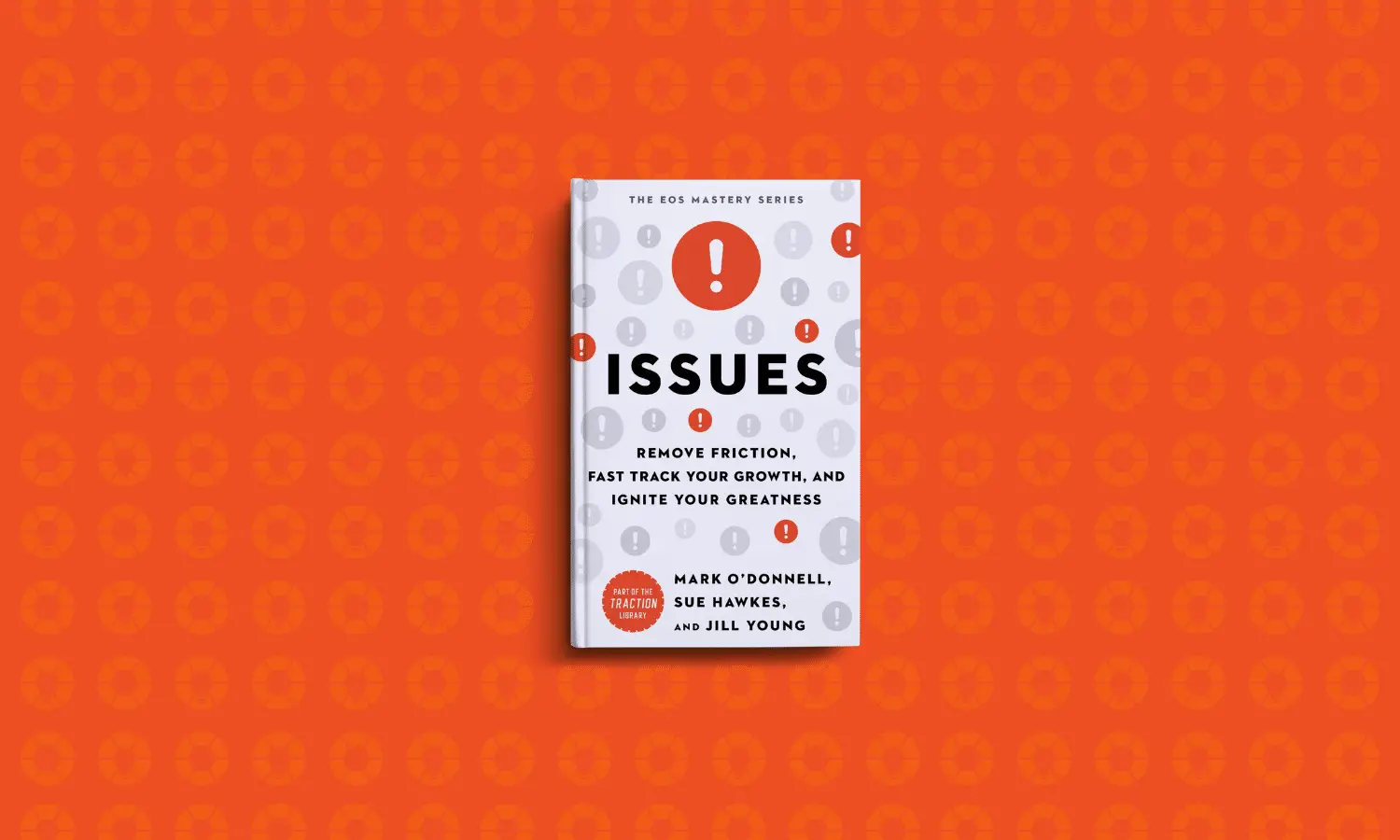
A Closer Look at the EOS Issues Component
Most leadership teams think they are pretty good at solving issues.
They talk about them.
They debate them.
They leave meetings feeling like progress was made.
But if you are being honest… how many of those issues are actually getting solved at the root and put to bed forever?
That is the tension this new EOS companion book Issues brings to the surface.
It takes one of the simplest components in EOS and reveals just how much depth is hiding underneath it. Not by reinventing the model, but by sharpening it in a way that makes you rethink how well your team is actually executing.
And in doing so, it quietly exposes where teams are going through the motions instead of truly solving issues.
One of the most important shifts in the book is how it reframes the Issues Component. It is not just one of six pieces of EOS. It is the mechanism that makes all the others work. Vision, People, Data, Process, and Traction all depend on a team’s ability to consistently surface, prioritize, and solve issues at the root. Without that, most organizations are not gaining traction. They are just getting more organized in their chaos.
The book also addresses something many teams do not talk about enough. A light Issues List is not a sign of health. It is often a sign that the real issues are still sitting under the surface. The gap between what is said and what is actually felt inside a leadership team is where most problems live. Bringing those issues into the open is where progress begins.
Before getting into the mechanics of the Issues List or the IDS process, the book makes a deliberate move to focus on something foundational: trust. Not surface level alignment, but the kind of trust that allows for real, sometimes uncomfortable conversations. The kind where people can challenge each other directly, assume positive intent, and stay focused on the greater good of the organization. Without that, no amount of process will fix the problem.
From there, the book walks through the IDS process in a way that feels both familiar and surprisingly fresh. Identify, Discuss, Solve sounds straightforward. In practice, most teams get stuck somewhere in the middle. Conversations drift, issues blur together, and progress slows. The authors do an excellent job of highlighting where and how that happens, along with practical ways to recognize it in the moment and course correct.
There are also subtle but powerful callouts throughout the book that will likely hit experienced EOS users the hardest. The moments where teams think they are being productive, but are actually avoiding the real issue. The internal assumptions that never get voiced. The tendency to stay in discussion instead of doing the harder work of solving. These are not new ideas, but the way they are surfaced makes them hard to ignore.
One of the more compelling themes throughout the book is that IDS is not just a leadership team tool. It is a discipline that needs to exist throughout the organization. If issue solving stays concentrated at the top, it creates bottlenecks and limits growth. The strongest organizations build teams that can identify problems, get to the root, and solve them consistently at every level. That requires more than process. It requires a culture where people feel safe to speak up, challenge ideas, and engage in productive conflict.
Another strength of the book is how it blends principle with real world application. Instead of just explaining how IDS should work, it shows what it looks like when it works well and when it does not. Those contrasts are where a lot of the learning happens, especially for teams that have experienced meetings that feel productive but fail to create real resolution.
And then there is the final section of the book. My favorite section that hits hard.
Checklists, Templates, and Tools.
This is where everything comes together in a practical, immediately usable way. It is packed with resources that teams can take directly into their next Level 10 meeting or IDS session. Clear frameworks, simple checklists, and tools that remove ambiguity and help teams build consistency. It is the kind of section that will likely get revisited again and again, not just read once.
If the earlier chapters create awareness, this section creates quick hit tools for teams.
For anyone running EOS, whether you are early in the journey or years into it, this book has more depth than you might expect. It reinforces the fundamentals while also challenging teams to raise their standard for what it means to truly solve issues and master this key component.
A huge thank you to Mark O’Donnell, Sue Hawkes, and Jill Young for putting this together. This is a meaningful addition to the EOS Mastery Series and one that will have a real impact on how teams find Traction.
If you are running EOS or considering it, this is worth your time and attention.
https://www.eosworldwide.com/issues-book