
The Emotional Journey of Running on EOS
There were three of us in that conference room, and I was the only one who left it lying to himself.
It was around 2015. An alumna from my Rice class, Lori Clements, had taken me to lunch at Forno’s of Italy, handed me a copy of a book called “Traction,” and told me she was starting her own practice as an EOS implementer. I barely cracked the book. I still have it, actually, signed by her, one of the older editions, sitting right in front of me as I write this. But at the time I thought I was doing her a favor. I told her I wasn’t sure the system was for us, and then, because I liked her and wanted to help, I offered to let her practice her sales pitch on my co-founder Charles and our head of marketing.
So she set up a ninety minute meeting. She asked us the same questions I now ask every client I sit down with in my own Professional EOS Implementer® work. Score yourself one to ten. Is everybody aligned around the vision? I said nine. I truly believed I held the vision and that everyone knew exactly what it was. Then my own team gave their scores. Fours. Fives. A six if I was lucky. On accountability, lower. On whether our meetings actually worked, lower still. And I sat there, a little stung, thinking they must have misunderstood the question.
They hadn’t. I had.
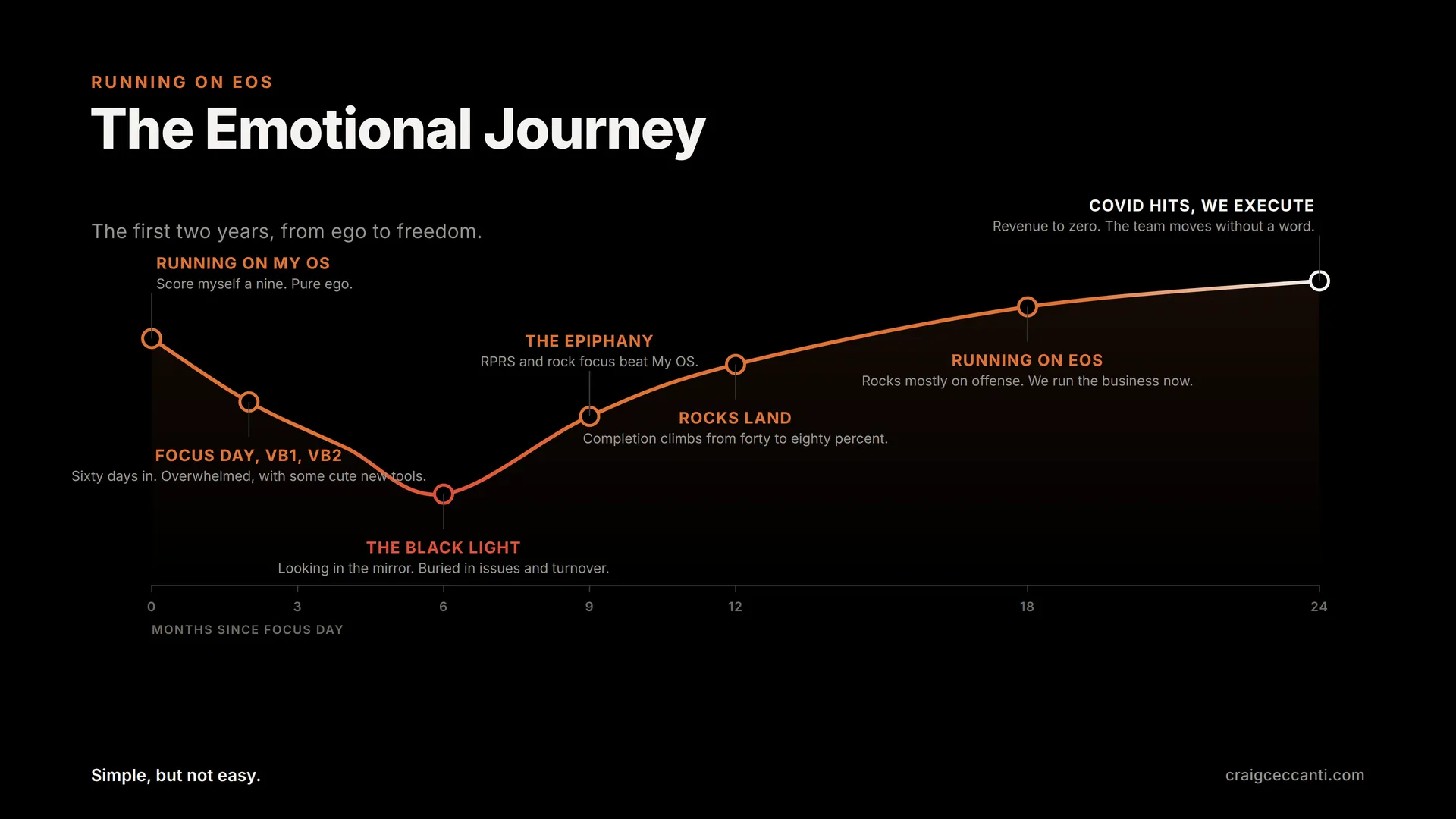
This is the raw, uncut version of what those first two years actually felt like. Not the tidy case study. The highs, the lows, and the breakthrough moments that finally turn it around, especially when you are doing it beside a co-founder you own the whole thing with fifty-fifty. And it is not only the founder who rides this. Whether you are the visionary, the integrator, or someone on the leadership team feeling the ground shift under your feet, you go through your own version of this curve. So before you hit the parts that scare you, I want you to see the whole map. It bends downhill for a while. Then it climbs. And it is worth the climb.
Let me back up, because the ego I walked into that room with was earned honestly.
We started Pinot’s Palette in 2009, first location in Montrose. It took a while to find product market fit. We had no idea what we were doing with marketing or sales, and we were moonlighting around full time jobs, running classes Thursday, Friday, Saturday. There were three of us in those early years. Charles and I were the co-founders, but his wife Beth was pivotal in the first year or two, shaping the product and figuring out what we were even offering. The three of us did everything.
Then we got lucky. A reality show on TLC called “The Little Couple,” filmed right here in Houston, featured us, and suddenly we were flooded with requests to franchise. We knew nothing about franchising. We learned what an FDD was, how to write a disclosure document, what it costs to get a location off the ground, all of it, mostly by figuring it out as we went. We opened a second spot in the Galleria, got comfortable with five year retail leases, and made the call to franchise as our main engine for growth. By 2012 and 2013 we were signing thirty and forty locations a year.
We did it on grit and a lot of tailwinds. And I will be honest, at the time I thought what we had built was pretty damn great. I was running what I now jokingly call Craig OS. Sheer brute force. I am smart enough, I can work hard, I can put in sixty hour weeks, I can wear eight hats, and that will be the solution to anything. Charles and I both have MBAs. We are builders. Our whole DNA said do it yourself.
What I could not see is that the very thing I was proud of was the thing holding us back. Everything routed through Craig. Technology went through Craig. Brand went through Craig. I thought I was the engine driving the company forward. I was the anchor. I was the bottleneck, and I was the last one to know it.
I was the anchor. I was the bottleneck, and I was the last one to know it.
After that ninety minute meeting, Charles and our head of marketing were clearly on the same page. It was full hell yes territory. We need this.
I was not there. I had a blind spot the size of a franchise territory, and I mostly went along with the crew. But here is the thing that got me to say yes. Charles and I are the same kind of do-it-yourself entrepreneur, and we both understood what this was going to cost over a year or two to install and actually master. So when Charles, of all people, looked at that price tag and said hell yes, that told me something. It told me there were things I was not seeing that we clearly needed. Huge kudos to Charles for not carrying around the ego and the Craig OS that I was. He was paying attention to the tools. I was paying attention to my own reflection.
So we said yes. Or rather, Charles said yes, and I said okay, whatever.
We showed up to Focus Day. Lori didn’t even have her office yet, so we did it in a conference room downstairs in our own building. We worked the accountability chart, and there it was in black and white. Charles and Craig, Charles and Craig, our two names stacked in far too many seats.
Then came the honest and genuinely uncomfortable conversation about splitting the visionary and integrator roles. Try doing that when you are fifty-fifty partners with someone. You look at a chart and you have to put one name on top of the other. We put me in the visionary seat and Charles in the integrator seat. If I am being critical of myself now, I am not sure I ever fully GWC’d that visionary role. Charles and I are both probably more natural integrators, and that has shifted over the years. That is a whole conversation I want to have with him on a podcast one of these days.
Here is what I wish someone had drilled into me before Focus Day. You do not walk out and reorganize the company the next morning. There is a stretch after Focus Day, before Vision Building, that stays inside the leadership room. Three foundational days, Focus Day and two Vision Building days, spread thirty days apart, on purpose. They are designed to let all of this sink in before you touch the rest of the company. Rushing it is dangerous. So for the first stretch we made almost no dramatic changes. Just more maturity about who owns what and who is accountable for what.
And I was still not committed. I showed up a few minutes late to our very first Level 10 meeting, which is exactly the thing you are not supposed to do. I didn’t have my to-dos done. My scorecard numbers weren’t in. I figured Charles, as the integrator, would carry all the homework, and I would keep floating along on Craig OS until this thing blew over and we went back to normal. Part of me genuinely believed it was a phase.
Vision Building was where the ground started to shift under me.
From roughly 2009 to 2017 our company values were something I had lifted from a former employer years earlier because they generally sounded right. Shout out Kalypso. Nice phrases like “characters with character.” They lived on a slide deck somewhere that nobody ever opened. We never talked about them. We never used them to make a single decision.
Sitting down and actually building our values was eye opening. So was thinking through core focus, which for us was a genuinely fun puzzle, because we recruit and sign franchisees and we also fill a studio with painters for a girls’ night out. Two very different whys living under one roof. These were strong exercises. And no, I was not a believer after Vision Building Day One. You rarely are. You do not do three full days and walk out in love with it. Maybe twenty percent of teams get there that fast. For the rest of us it takes time to work, the same way it takes companies years to find their hedgehog concept in “Good to Great.” Our core focus was our hedgehog, and we were still hacking away at it. Through all of it, every time I dug in my heels, Lori kept reminding us of the same thing. Follow the process. It works for thousands of companies and it will work for you.
The place I pushed back hardest was annual planning. Lori flipped it right around on me. Craig, she said, what do you tell your franchisees when they want to change everything on day one? I gave her our own catch phrase without even thinking about it. You take the car around the track a few times before you start swapping tires and suspension and paint. We know this car works. And there it was, the mirror held up exactly where I needed it. The car she was talking about was EOS. I was the franchisee trying to rebuild it before I had run a single clean lap. If I trusted the process enough to sell it to everyone else, I had to trust it enough to keep myself onboard.
By the time we finished Vision Building Day Two we had a solid Vision Traction Organizer. I was still creating sideline rocks, still trying to invent rocks for other people, still doing too much. But we had something real on paper for the first time.
Because of our size and shape, about twenty people, everyone in one office rather than out in the field, we chose a full rollout right after Vision Building Day Two. That is not right for everyone. Bigger or more dispersed teams, or teams facing a dramatic accountability chart change, often roll it out in layers instead. But for us, a big bang made sense.
I led that ninety minute town hall. I still have the deck. I talked about the values, because culture landed squarely on my seat and I was finally committed to it. We had the accountability chart printed out. We explained GWC. We told everyone we would be sitting down with each of them one on one. It was starting to feel real. About sixty days in, we had our first real set of rocks on the leadership team, the rest of the company was just getting oriented, and we committed to department level Level 10s to follow.
And then all the issues came pouring out.
Here is the best way I can describe those first couple of quarters. EOS is a black light in a hotel room. You turn it on and suddenly you see every impurity and imperfection you had been walking past for years. People issues. Process gaps. Missing data. It all lights up at once, and it is overwhelming, and your ego shrinks a little more every time the light finds something new. Your long term issues list grows. Your short term issues list grows. You have a pile of rocks to finish. You are trying to reshape an entire organization while it is still running.
What is actually happening, though you cannot feel it yet, is that you are climbing. You are moving from a company that is maybe twenty percent strong in each component to one that is sixty percent strong. Enormous leaps. It just does not feel like progress, because none of it looks like growth.
This is the feeling I most want to save you from misreading.
As a founder and an owner, you want revenue up and profit up and territory expanding. But the rocks you are doing in those early quarters are not the rocks that unlock new revenue. They are defensive. You are paying down debt from the past. Process debt. Technology debt. Structure and accountability debt. You might have a rock just to build a real financial and accounting calendar. That does not move the company forward on any chart your investors care about, and it is absolutely necessary, because we never put that foundation in from the beginning.
For me a huge piece of that debt was learning to let go of the vine. Learning to delegate. Learning to trust people once we had the right ones in the right seats, instead of routing everything through myself.
So you hit six months and you think, we have been at this for half a year and we have not moved the company forward. Then your second quarterly comes and it smokes out even more issues, and your issues list gets longer, not shorter. It feels like defense, defense, defense. I promise you that is by design. Think about any sport, or think about chess. Going on offense before your footing is sturdy leaves you wide open, and it comes with enormous risk. Push your pieces up the board before your position is solid and a good opponent makes you pay for it. You cannot go on offense and stay there without a strong team underneath you, and building that team is the whole job right now. You pay the piper first. You are laying bedrock. You cannot build the offense until the foundation will hold it.
The hardest debt to pay down was cultural, and most of it was mine.
Looking back, my mistake was that I cared too much about being everyone’s friend. That turned into tolerating far too much. And what you tolerate, you endorse. Someone would simply not show up most Mondays and burn unpaid leave, and the real damage was not to me. It was to the committed people watching that behavior go unaddressed and quietly recalibrating how much they needed to care.
Lori had warned us on day one. When you have never defined your values or your right seats, and you finally do, some people are going to realize this is no longer the organization for them. And you cannot blame them, because you never told them what kind of organization you were or what you expected of them day to day and quarter to quarter.
So we did the work. I took every single person to lunch, one on one, and tried to talk twenty percent of the time and listen the other eighty. We went to Outback so often I ate more steak salads than any human should. About twenty percent of the staff, five or six people, resigned over that stretch. We did not have to terminate a single one. They saw the change coming and chose to find a better fit, and I am grateful for their honesty.
Here is what surprised me. The moment that turnover settled, the energy in the building changed. You could feel it walking in the door. The people who stayed understood the VTO, the core values, the core focus, where we were headed and how we would get there. They were not just employed. They were bought in. That changes everything.
One quick sidebar, because it tells you something true about visionaries and conflict. I was called mom in our company and Charles was called dad. Sometimes people needed mom and sometimes they needed dad. Visionaries famously do not love conflict, and EOS made the hard conversations easier, because it was no longer Craig inventing a confrontation. It was just how we run. We run on EOS, which means every quarter we sit down and talk honestly about how we are doing, both directions, including their feedback for me.
Two moments cracked me open.
The first was a marketing director named Natalie Wells. She started as one of our early artists, helped with graphics, and became a genuinely brilliant strategist. I came charging into her office one day with a shiny new idea. Google was rolling out its Mobilegeddon update, prioritizing mobile optimized sites, and I needed her team on it now. She looked at me and said, Craig, I have my list of rocks. If you would like me to swap one of them, we can bring it to the Level 10 and discuss it as a team.
That stopped me cold. My own operating system had just protected the company from me. As the visionary, chasing shiny objects was practically my job description, and now there was a structure that would not let me unilaterally blow up anyone’s priorities. It did not just protect the team. It gave me a safe place to park my ideas, knowing they would get processed when we all agreed they mattered. Our rock completion rate climbed from forty percent to sixty to eighty. For years we had been finishing ten percent of a hundred things. Now we were finishing a hundred percent of forty.
The second moment was about nine months in. I had always been our head of technology, my background is in building software, and our head of innovation, because that was my consulting world. Every time prospective franchisees came to town for Discovery Day, I presented those sections myself, religiously, certain I was simply the best at it. But the accountability chart now had a real head of technology and a real head of innovation, and someone made the call that they would present instead. So I sat in the back of the room and watched.
And I thought, holy cow. They just did that better than I ever have.
That was the morning my eyes actually opened. Letting go of the vine did not lead to a worse result. It led to a better one. It took me longer than most to see it, and I owe a lot of that stretch to Charles, the best integrator I have ever seen and one of the most efficient people alive. He kept the trains on time. If it had been left to me, we would have ditched the book in the first month and gone right back to Craig OS.
Around this same time I took stock of my life. By 2018 I had three kids under three at home. It had been an intense couple of years on every front. And I was finally reaching the point where I did not need to work nights and weekends, because I had learned that the work got done better and faster when I was not the one doing it. That is not a soft benefit. That is the whole point. Give people clear roles and real ownership, then let them go, and you get your evenings back.
Somewhere around the year to year and a half mark, the whole feeling flipped. Early on, if a leadership team has twenty five rocks, maybe five of them start turning offensive. Build something new. Open a new territory. Drive new revenue. By eighteen months, roughly eighty percent of our rocks were offensive. That is the shift, and that is where it gets genuinely exciting. You are running the business instead of the business running you. You can take a vacation. You can sleep on a Saturday without bracing for the website to crash while nobody knows who is on call. You can be fully at your kid’s birthday party instead of half there.
We had a system for everything by then. We used the three step documenter and knew exactly how much process we had built and how much was left. We got strong at the issues component. Right people, right seats. A clear vision the whole company could recite. Even our franchisees noticed the maturity coming out of headquarters, and a lot of that was simply doing less, better, instead of doing everything, frantically.
That was when I became a full on evangelist. I still wonder what we could have been if we had found this in 2011 or 2012 instead. But I am grateful we found it when we did, and, as it turned out, just in time.
If you take one thing from my two years, take this. We say EOS is simple but not easy, and this is exactly what we mean.
The tools are simple. There is vocabulary to learn, sure, but it is no harder than ordering at Starbucks. If you can navigate that menu, you can navigate this. What makes it hard is not the tools. It is what the tools uncover. Every skeleton in the closet, every bad habit, every unspoken thing that has lived in people’s heads for years gets pulled out and put on paper. Then you have to actually deal with it. You have to have the hard conversations. You have to make the hard calls, do less, drop some offerings, disappoint a few customers you have been overserving for years. You have to slow down so that you can speed up later. None of that is easy.
So if you are early in this and you feel completely overwhelmed, if every rock feels defensive and the company feels no closer to where you want it, I want you to know that is not a sign it is failing. That is the sign it is working. Those feelings, in that order, are normal. You are not behind. You are exactly where the foundation gets poured.
And here is why it is worth pouring. A couple of years after all that hard work, we were a great company. Rock solid. Then COVID hit, and overnight our revenue went to zero. We ran one of the largest paint and sip chains in the country and the doors were shut. And the team knew exactly what to do and where to go without a single word from me. It was like watching an elite special forces unit go to work with almost no need to communicate. It was amazing. What should have ended most companies was a bump in the road for us, and that same foundation carried us all the way to a successful exit in 2023. That is a glory days story for another day.
I am not going to tell you that it is easy. But I am going to tell you that it is worth it.
C