
Rock Mastery: Run Your Rocks Before They Run You
It’s day 45 of the quarter and you haven’t touched your Rock. I’ve lived that cram more times than I want to admit. After more than a decade of running Rocks™ as an operator, and now watching teams do it as a Professional EOS Implementer®, this is the system that moves Rock completion from 50 percent to 90, and it all happens in the first two weeks.
Okay, so here we are. It’s the beginning of the quarter. You just received a Rock. It might be your first Rock ever, or maybe your hundredth, but this is going to be the trick to how you master Rocks. How you run Rocks and not let them run you. Because what tends to happen is we get excited. We know it’s the most important thing to help the company, to win that quarter, to win the year. And what happens? Before we know it, we’re 45 days in. We haven’t even touched the thing. Our on tracks start to sound like “on track,” and then they start to come off track way too late. We hit roadblocks. Everybody’s cramming at the end of the quarter to get their Rocks done. So we’re hitting blockers. Calendars are full all over the place.
So here are some tricks and tips. I’ve been doing Rocks for more than a decade. Some things I’ve learned, some big mistakes I’ve made along the way, for you to use yourself.
Rocks are not simple. They’re hard. They’re tricky. We have to rely on other people. We can’t say, well, I’m just going to write Rocks that don’t rely on anybody else. That’s a cop out. We can do this, and we can do it with some simple things on how to execute a great Rock.
The first thing we do: we win before the session even starts. We know the Rock setting quarter is coming. We live in the 90-day world, and one of the tools we can use is our Clarity Break. We sit down with our notepad. We think about the big picture. What are the things I need to work on in the business? We can stub out a lot of the Rocks we know we’re going to want to do before we ever walk into the quarterly session. If we’re on the leadership team, or a member of a department, we’re still going to have our quarterly rollover. Maybe it’s in the shape of an L10, but at some point someone’s going to look at us and say, hey, what do you think the most important things for you to get done over the next 90 days are? And you should have that prepared.
Your brain doesn’t work well if you show up and your brain’s blank and your paper’s blank. So have that pre-thought. It can really help you get ahead. I’m not talking hours. I’m talking five, ten, twenty minutes thinking about these things. How much of that could I get done realistically? Do some pre-thinking. It helps tremendously. That’s point number one.
Point number two: once we get this Rock, it’s the first week. We need to start working right away, off the blocks. I’m doing this on day one. I use the Rock Planner tool. You can download it right there, free, no email required, so anybody and everybody can use it. It’s a simple tool, and this isn’t a long process. This is five, ten minutes per Rock.
Here’s what we’re doing with the Rock Planner. We’re identifying who our stakeholders are. Who do I need to consult, meaning I need their feedback? You could even use the RACI paradigm, who’s responsible and accountable, but more important to me is who I need to consult and who I need to inform to keep in the loop as we go. This prevents us from getting to the end of the quarter, saying “this Rock is done,” and having people go, it is? Identifying the stakeholders up front kills that moment.
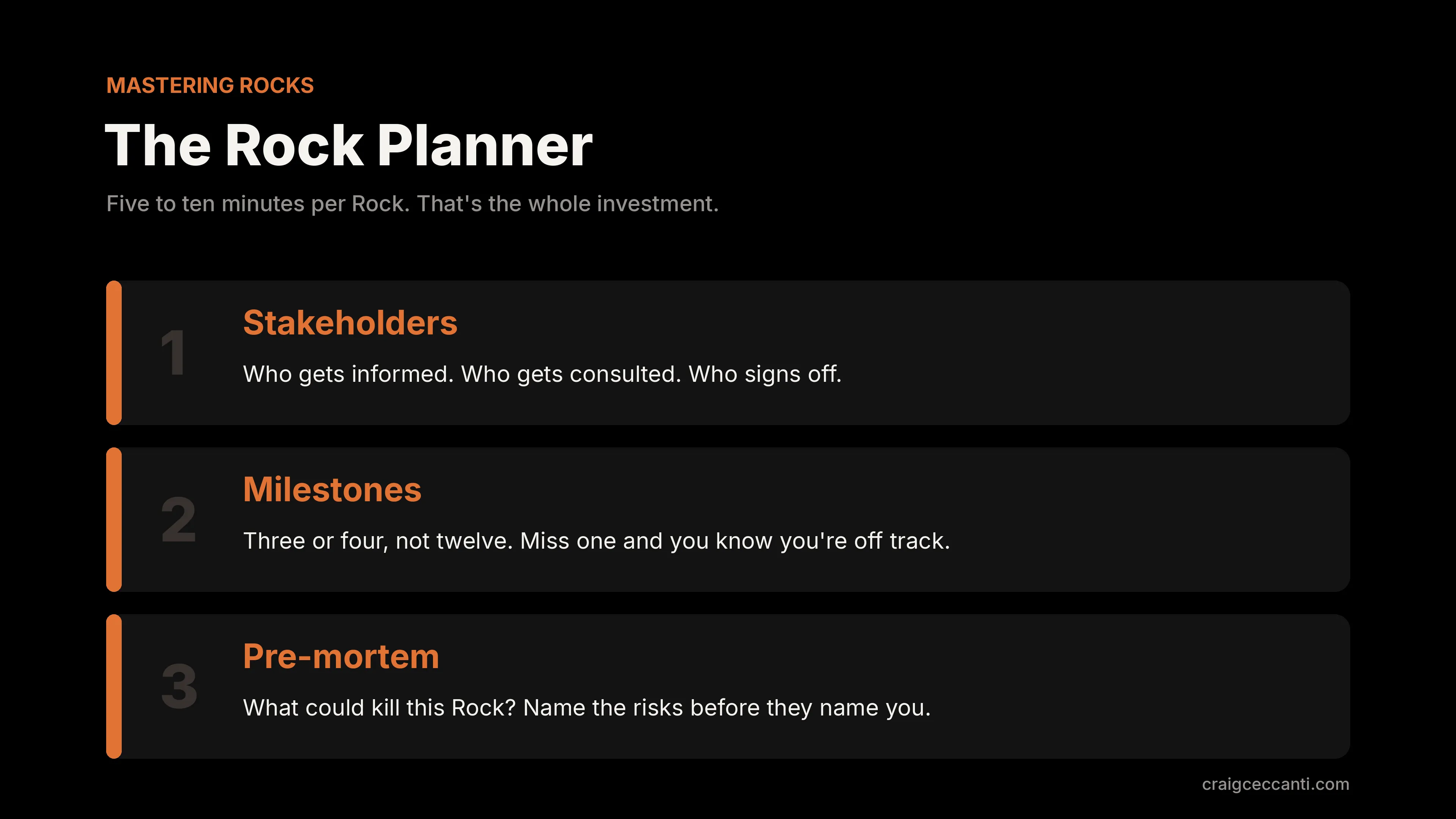
The next thing we’re doing is creating the milestones. What are the major two, three, or four steps you would observe throughout the quarter? Not twelve. The major milestones, so you know whether it’s on track. This also creates a mini project plan you can share with other people to make sure we have alignment. Many times our Rocks have prerequisites, or our Rock is a prerequisite for another Rock, and this helps align those things so we’re not getting in each other’s way.
The last piece is one of my favorites: a pre-mortem. For any project manager out there, this is just a risk assessment. What could go wrong? We ask ourselves, hey, it’s the night the Rock is due and it failed. What went wrong? If we can think about these things in advance, we can mitigate the risks or come up with a workaround. Doing that alone, without sharing it with anybody, will improve your Rock completion percentage by double digits. Sharing it helps even more.
And that’s phase three. We’ve thought about it in advance. We’ve used the Rock Planner. Now we’re sharing and discussing it with people and getting alignment. This is all within the first week to ten days of receiving a Rock. I’m sharing it with my leader. I’m sharing it with my teammates. I’m walking through it. Even if I have to buy lunch for someone, I am walking them through it and making sure we have alignment. I’m defining what done means. I’m asking for blind spots. What am I missing here? You’ll get all kinds of great information. Hey, that attorney you’re relying on always takes vacation in July, so you can’t expect work from them during that period. You’ll miss that milestone. Great. I’m glad I know that now.
And then, half jokingly, I want whoever I’m reporting to signing off on this plan. Sometimes I literally say, okay, here’s the pen, sign it. And they’ll sign it. Or we just get verbal confirmation that this is what done looks like. We write Rocks SMART, but there is still a lot of gray area in there, and I don’t like leaving it up to a tie goes to the runner. In our case, whether a Rock is done or not usually goes to our manager. So we want to lock that down the best we can. This is good project management, and it’s the most important thing for the company.
Every once in a while, this planning cycle catches something. You’ll find a small word in the Rock that makes it much harder than everyone intended. You have about a five-day window to go back to your team in the next L10 and say, hey, I want to tweak this word, and here’s why. There’s some allowance for making that small tweak when you’re just a few days in. That doesn’t fly when you’re five days from the end of the quarter saying it’s done, but I had to change this word. No go. That’s not accountability. So think about it, dig in, and use that first ten days to get it right. If you do that, you’ve done the hard part. Now we just have to execute.
The fourth thing I’m doing, and this is probably in the first two weeks, is getting all my meetings booked. These are the milestone meetings. If I have a workshop where I need the team together, I’m setting that date now, because everybody’s schedules are busy. I’m setting my review meeting with my manager, and I’m not setting it the night before the quarterly session when these Rocks are due. I’m setting it two or three weeks prior, because I’m likely going to get some last minute feedback. Yeah, I think you’re done here, you’ve just got one more yard to go, and it’s this thing. Make this tweak and I’m good on this Rock. Now you’ve got time to correct with that extra feedback. If you wait to book your meetings, guess what? Everybody’s trying to get reviews and feedback and their Rock over the finish line at the same time, and the calendars will be full. Get your meetings on the calendar right away.
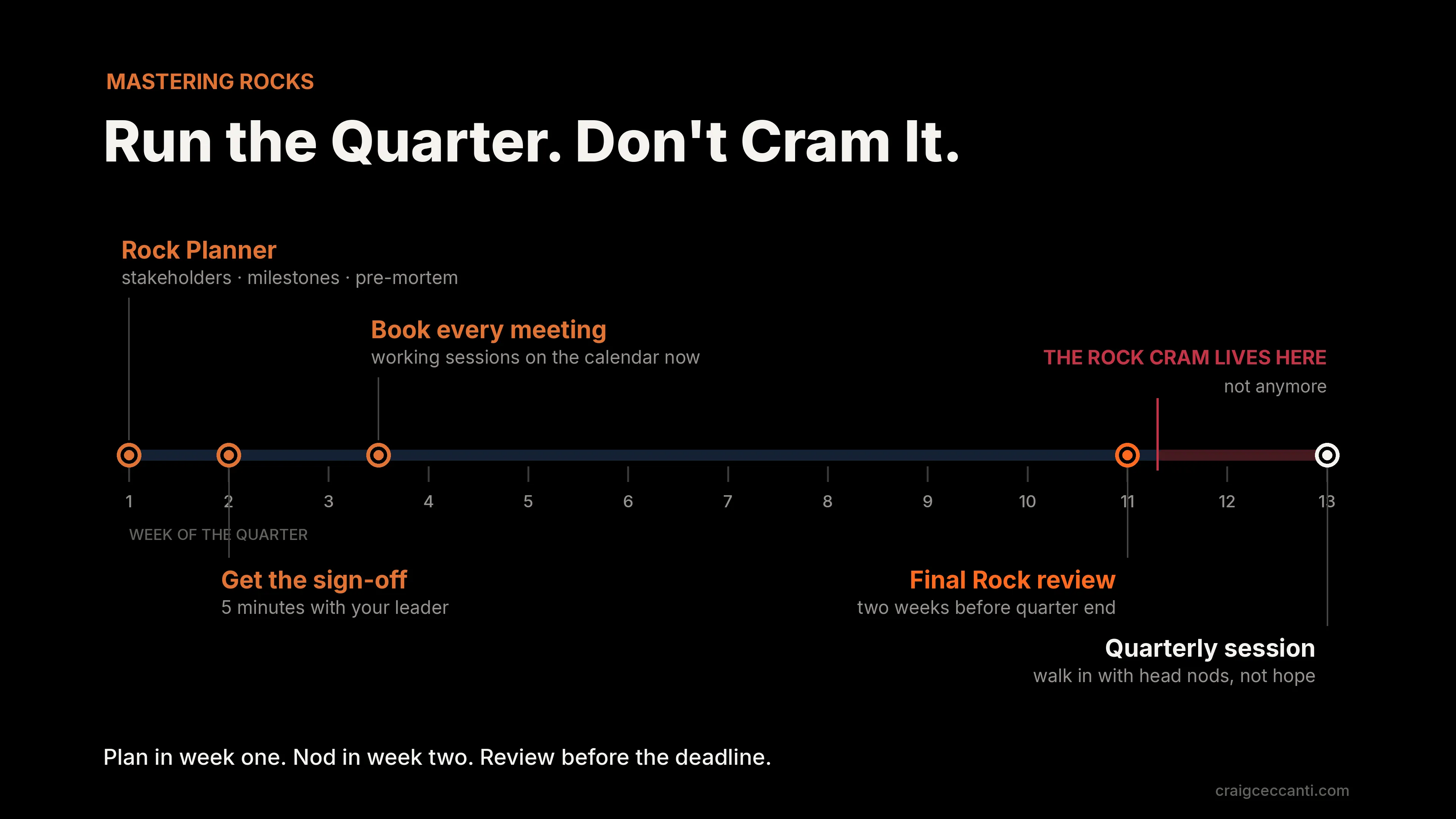
If you’ve done those things in your first two weeks, your Rock completion percentage has now gone from the 50 or 60 percent average to 80, 90. You’re going to hit some hundreds. This is where Rocks are won. Then we just go execute. We use the team, and we’re not afraid of saying off track in our L10 meetings. Off track is not a means of failure. It’s I need help.
Off track is not a means of failure. It’s I need help.
You should wave that flag early. If you need help and you think there are real challenges, use that time with the team. We’ve all agreed these Rocks are the most important thing for the business. So wave the flag and get help when you need it.
Two things I’ve seen, both as someone who’s executed Rocks and as a manager of teams with hundreds of Rocks in a quarter. You see two different kinds of execution. One is just silent. A Rock gets assigned and you never hear about it. It’s on track, it’s on track, it’s on track, and in the last week it goes off track. Or maybe worse, it stays on track and then someone says done, and you’re thinking, I haven’t seen anything. Can you send it to me? You don’t get it. A week or two goes by, still no work product, and you’re left questioning and wondering. Eventually it’s, hey, I didn’t get it done.
Versus the other way. Let’s say both of these Rocks fail. In the second version, someone came out of the gate, they planned, they showed me their Rock plan, they booked the meetings, we did workshops and feedback sessions, we checked in, and the Rock still didn’t make it. Which one would we rather have? In one of them, I’ve seen all the work. I’ve been taken along the whole journey, without a lot of my time, just quick check-ins. I’d much rather have that second one. I think we all would. We’ve seen the work. We have trust that someone is caring for this thing and that getting it done matters to them. Just by operating that way, you’re going to build trust with your team. And when a Rock doesn’t get across the goal line at the last minute, nobody’s worried about your performance. Nobody’s questioning your accountability or whether you live the values of hard work or do what you say. They’ve seen you do the work. So lay it out.
These things trickle down. How you handle your work, how you organize it, how you communicate, how you work within the team and get things over the finish line. This is where you walk the talk. Your team sees you operate this way, peers, managers, people who work for you, and they’re going to follow it. They’re going to see execution at a different level and they’re going to want to copy it. If you’re operating at this level of Rock mastery, more Rocks get done, more Rocks get done on time, and you take away all of that stress from the cram period in the last two weeks. By then everybody’s saying done two weeks out, with a few small tweaks, with feedback from everybody on the Rock Planner as stakeholders. It gets a lot smoother as you glide into the next quarter. And now you’ve got a clear head to go do your Clarity Break and prepare for what’s next.
So let’s remember: 80 percent is the goal. Not a hundred. We’re driving to 80, and more importantly, how we get there. This is going to be less stressful for you, because you’ve done the planning, you’ve done the thinking, you’ve brought your team along with you, and you’re going to complete more Rocks. And remember, the path to success is paved in rocks. Go get them.