
Whose Rock Is It? Company, Department, and Individual Rocks in EOS
We’re deep into a Quarterly. Rocks are up on the board, names are going in the who column, and the room has that good tired energy where real decisions are getting made. Then somebody sets down their marker and says, half apologizing for asking, “Hold on. Is that a company rock, or is that my rock?”
And the room stops. Not because it’s a hard question. Because four other people had been sitting on the exact same one and nobody wanted to be the person who admitted it.
This is the most common question I get in the session room. It comes up with almost every team, usually in the first two or three quarters, and it never comes up loudly. It surfaces sideways, in a hallway or right at the end when we’re packing up.
I used to answer it badly. I’d give the textbook definition, watch everyone nod, and move on. Technically correct, completely useless. The nod meant they’d stopped asking, not that they understood. It took me a while to notice the difference.
So here’s the answer I give now.
A Company Rock is one of the three to seven most important things that have to get done for the whole business in the next ninety days. An Individual Rock is one of the three to seven most important things that have to get done by one specific person in the next ninety days.
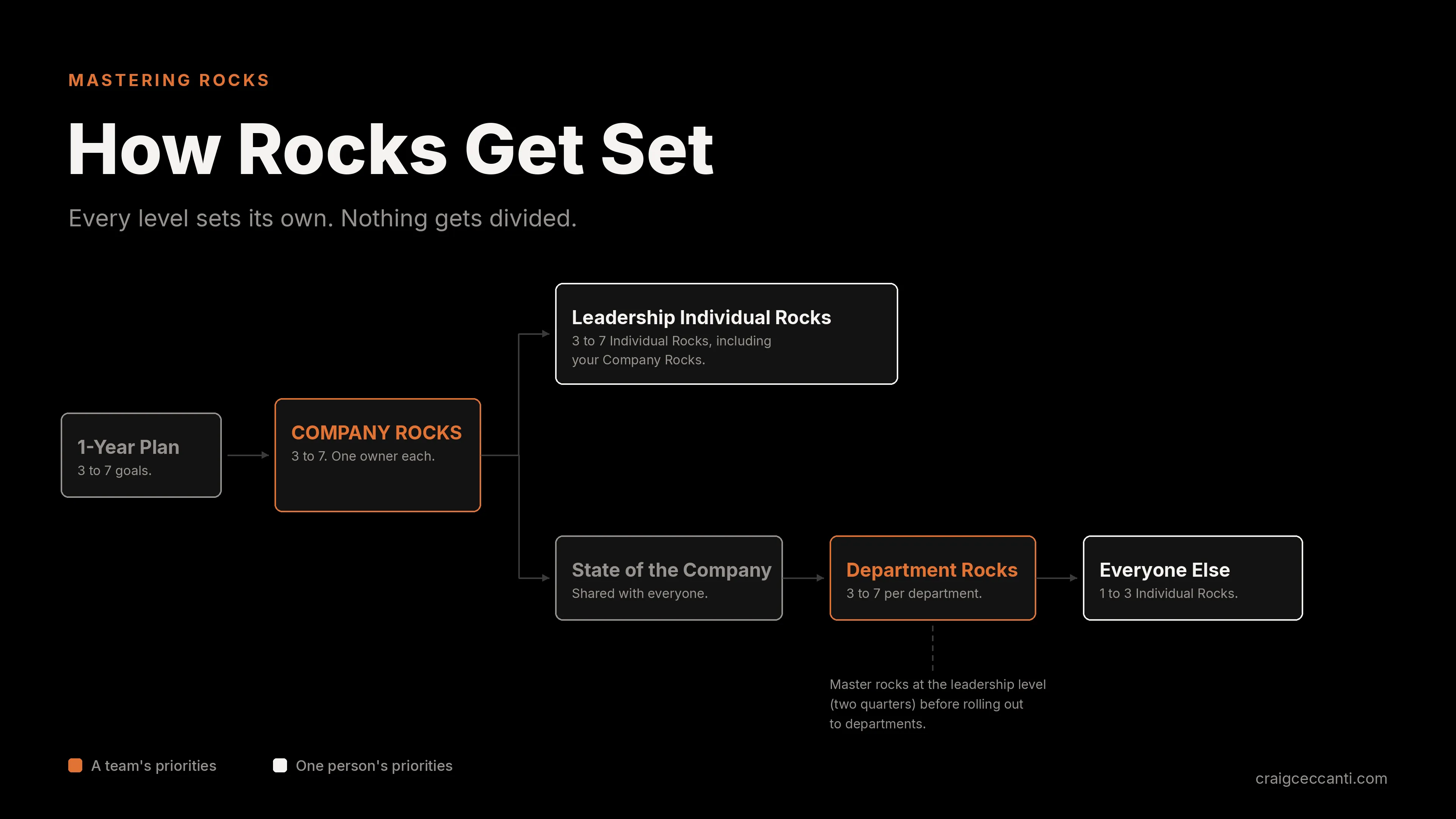
They’re not two different species. Every Company Rock has exactly one owner, and that rock goes straight to the top of that person’s individual list. Which means a Company Rock is also an Individual Rock. Both, at the same time, always.
A Company Rock isn’t a different kind of rock. It’s an Individual Rock the whole company is counting on.
The confusion starts because teams hear “Company Rock” and think it belongs to the company. And “the company” is a very comfortable way of saying nobody. That’s how you end up with vague, collective-sounding rocks that everybody agrees are important and nobody actually drives, and a quarter that ends in a lot of explaining.
The fix is one name in the who column. Not two. When two people are accountable, nobody is. The owner doesn’t have to do all the work, but they build the timeline, they call the meetings, they chase the people who owe them things, and at the end of the quarter everyone looks at them. Put a single name there and the fog lifts almost immediately.
Now the part that trips up the second wave of questions.
Company Rocks travel in two directions at once. They go down to the leader who owns each one, becoming that leader’s top Individual Rock. And they go out to the whole organization at the State of the Company meeting, which is short, happens every quarter, and is the only reliable bridge between what the leadership team decided and what everyone else thinks is going on.
Then each department team sits down and runs the same process the leadership team just ran. They look at the company priorities, they look at their own work, and they set their own three to seven. Some of those support a Company Rock. Most won’t, and that’s correct. A department has its own job to do.
Which brings me to a phrase I’d like to retire. Rocks don’t trickle down. Nothing gets chopped into smaller pieces and handed downward. What actually happens is alignment, not division. Every level sets its own rocks using the same process, and all of them point at the same vision. The moment a team hears “trickle down” they start doing math, taking Company Rock number three and splitting it into four department rocks and twelve individual ones. That’s not the system, and it makes for a miserable ninety days.
A few questions that always follow.
Does a Company Rock count against my three to seven, or is it extra? It counts. If you own two Company Rocks, you’ve got room for one to five of your own.
What if a Company Rock needs work from four different departments? It still has one owner. They don’t do all the work. They drive it, and they answer for it at the end of the quarter.
What if I don’t own a Company Rock this quarter? Then all of your rocks are your own. That happens, and it’s fine.
Can a Department Rock just be a copy of a Company Rock? Almost never. If the Company Rock is launching the customer portal, the operations rock might be loading every active customer record by March first. Different rock, same direction.
When do departments start setting rocks? After your leadership team has run two full quarters on its own. Two. You’re going to make mistakes early, and you want to make them at the top of the house where a handful of people can learn from them, not after you’ve asked sixty people to run a process you haven’t figured out yourself.
That last one is the piece nobody wants to hear, and it’s the one I’d protect most. The first quarter is a practice round. Expect to complete about half your rocks, expect it to feel clumsy, and expect the number to climb with repetition rather than effort. Actually driving a single rock across those ninety days is its own skill, and I walked through the whole system for that in Rock Mastery.
If your team is somewhere in those first few quarters and this question has been sitting unasked in the room, ask it out loud at your next Level 10 Meeting®. My experience as a Professional EOS Implementer® is that the person who finally says it is speaking for at least three other people, and the whole thing gets easier the moment it’s on the table.