
Part 1: The Moment Your Startup Has to Grow Up
I remember sitting in a conference room in 2015, eight hats on my head and sixty-hour weeks in my rearview, thinking I had built something great. And I had. The problem was I had also built something that was about to eat me alive.
Nobody handed me a map for that part.
That’s what this series is about. I want to give you the map I didn’t have. Not the glamorized version you see on the conference circuit, where every founder story ends in a clean exit and a TED talk. The real one. The one with the ugly middle, the sleepless nights, and the moment you realize the thing you built is running you instead of the other way around.
I’ve lived this journey as a founder, as an operator, and now as a Professional EOS Implementer in Houston working alongside leadership teams who are somewhere on this road right now. I’ve seen it from every angle. And what I can tell you is that the journey follows a pattern. It is not random. It is not unique to you. And if you know what’s coming, you can stop being blindsided by it.
Let me walk you through it.
Over the years, I have drawn versions of this on whiteboards, napkins, and conference room glass. It started as a way to explain the journey to my own teams. Then I started using it in workshops with Houston founders and startup communities, most recently at the Ion, where I had the chance to walk a room full of entrepreneurs through it. The conversation that followed told me this map was hitting a nerve.
So here it is.
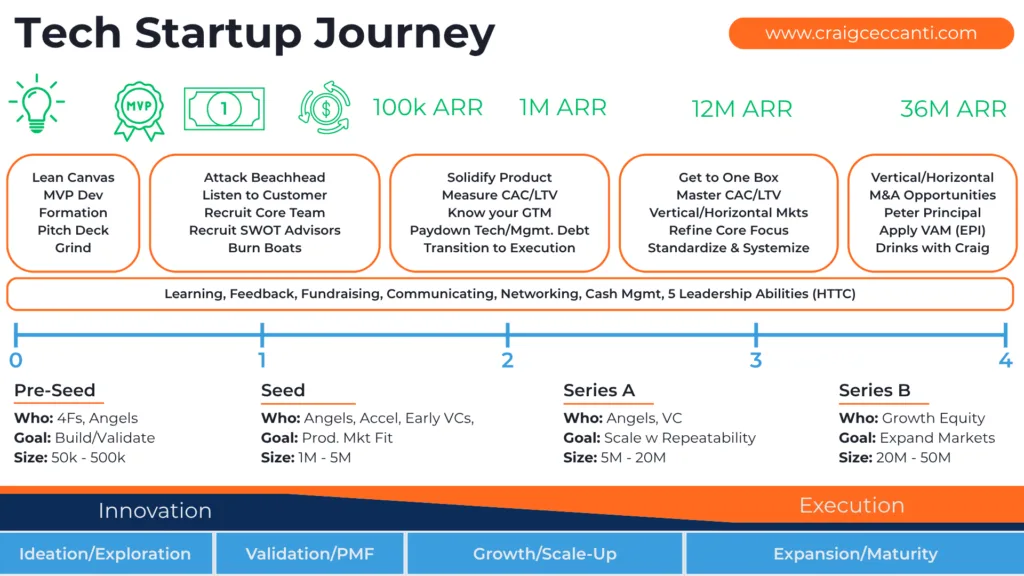
This graphic is the backbone of this entire series. It maps the full arc of the tech startup journey across four stages: Ideation and Exploration, Validation and Product-Market Fit, Growth and Scale-Up, and Expansion and Maturity. For each stage, it tracks where you are with traction, what you should be spending your time on, where the money comes from, and the pace and tone of innovation inside the company.
We are going to walk through all four stages in this article. In Part 2, we will come back to this map and look closely at the inflection point sitting right in the middle of it, the moment the trajectory of your company changes and most founders do not see it coming. In Part 3, we will talk about how to make the transition without losing the thing that made you great in the first place.
For now, start at the left. That is where every founder starts.
Ideation and Exploration
You wake up and the idea won’t leave you alone.
Maybe it’s been building for months. A problem you keep bumping into. A gap in the market nobody seems to be filling. A “why doesn’t this exist yet?” that finally gets loud enough to act on. So you do something about it. You quit your job, or you start moonlighting, or you find a co-founder crazy enough to believe in it with you.
This is the Ideation and Exploration stage. It is equal parts exciting and terrifying, usually at the same time.
Your entire job right now is clarity. You need to take a complex, swirling idea out of your head and get it into something another human being can understand in five minutes. A Lean Canvas. A pitch deck. A one-pager. You are not trying to build the whole thing yet. You are trying to prove that the thing is worth building. Who is your customer? What problem are you actually solving? Why are you the one to solve it? These are not rhetorical questions. They are the whole job.
You are operating on nothing. No revenue, no team, no traction. Just your own conviction and maybe a small friends and family round to keep the lights on. Pre-seed capital, if you can get it, comes from people who are betting on you as a person, not on a proven business model. Because there isn’t one yet. In Houston, those early conversations might happen inside the Mercury Fund ecosystem, the Houston Angel Network, or through the Rice Alliance. They have seen hundreds of founders walk through the door. They know the difference between passion and a plan.
At this stage, innovation is at a full sprint. You are building, scrapping, rebuilding, and pivoting, sometimes all in the same week. That is not chaos. That is the process. Embrace it, because it will not always look like this.
Validation and Product-Market Fit
You have got something. It is rough and imperfect, but it is real. A minimum viable product in the hands of actual users. Some of them are paying you money for it.
Your first dollar. Frame it. Seriously.
The Validation stage is where startups find their footing or slowly unravel. Your entire focus is product-market fit. That magical, elusive state where your product solves a real problem for a specific group of people well enough that they would be genuinely upset if it went away. This is your ICP. Your beachhead. The narrow wedge you are going to drive into the market before you think about anything else.
You are still iterating constantly. The Lean Canvas is not a document you made in Month 1 and filed away. It is a living thing you are updating as you learn. Your pitch deck is evolving. Your customer conversations are teaching you more than any internal strategy session ever could.
Seed funding becomes a real conversation here. Investors want to see signs of life. Early revenue. User growth. Engagement data. A customer or two who will get on a call and tell someone else this thing works. In the Houston startup community, this is when relationships start to matter in a different way. You are not raising on a dream anymore. You are raising on evidence.
And you are still running fast. Innovation is still at the center of everything.
But something is starting. You have a few more people now. Communication that used to happen naturally between two co-founders now requires actual effort. Decisions that used to take five minutes now take a week because nobody is clear on who owns what. You probably have not noticed it yet.
You will.
Growth and Scale-Up
You have crossed $100K ARR. Maybe you are pushing toward $1M. Customers are buying, the team is growing, and there are days when it genuinely feels like you are going to make it.
This is the Growth and Scale-Up stage. And it is the most dangerous stage on the entire map, precisely because it feels so good.
Here is what is actually happening underneath the surface. Everything is breaking.
The systems that worked when you were five people do not work at fifteen. The communication style that made you effective as a scrappy startup creates chaos in a growing company. You are hiring fast, maybe too fast, and not everyone you brought on is the right fit. You are starting to see accountability gaps. Things fall through the cracks. Fingers get pointed. Nobody quite owns the outcome.
If you are a Houston entrepreneur who has ever hit a business growth plateau right when things were supposed to be taking off, this is usually why. It is not the market. It is not bad luck. It is the fact that your company has outgrown the way it is being run.
Series A capital is on the table for the right companies at this stage. Investors want to see scalable unit economics, a repeatable sales process, and a leadership team that can actually execute. The bar is higher because the risk profile has changed. You are not validating a concept anymore. You are proving a business.
And here is the thing about innovation at this stage that most founders do not want to hear. It has to start slowing down.
Not because creativity stops mattering. Not because you stop caring about the product. But because the company needs something different from you now. The market has given you signal. You know what works. The job is no longer to invent. It is to scale what you have already proven. Every time you chase a shiny new feature or pivot the strategy without a real system behind the decision, you cost your team velocity and your company momentum.
Founders who cannot make this shift are the ones who end up stuck, overwhelmed, and wondering why scaling a business feels impossible even when the revenue is growing.
This is where most founders first feel it. The ceiling.
Expansion and Maturity
You made it through the chaos of early growth. Revenue is climbing. The team is bigger. You are moving into new markets, new verticals, new opportunities.
This is the Expansion and Maturity stage. And it is where the gap between great operators and everyone else becomes impossible to ignore.
Series B and beyond is in the picture for the companies that have figured out scalable growth. Strategic investors. Private equity. Even M&A conversations start to surface. You are not a startup anymore.
You are a company. And companies require fundamentally different things than startups do.
They require systems. Clear roles. Real accountability. A leadership team that is genuinely aligned, not just on the surface but in the hard conversations, in the moments when things are not going well. They require a Visionary who can see around corners and an Integrator who can turn that vision into daily execution. They require the kind of operational discipline that most founding teams have to go learn the hard way, because nobody in the startup world lines up to teach it to you.
Innovation does not stop at this stage. But it gets channeled. It becomes intentional. You are not innovating to survive anymore. You are innovating to lead. There is a real difference between those two things.
The companies that build something truly durable are the ones where leadership stopped operating like a startup and started building like a company. Where someone, at some point, had the clarity and the courage to say: it is time to grow up.
That moment, that specific inflection point between building a product and building a company, is what we are going to dig into in Part 2.
Because recognizing it is everything. And most founders miss it until they are already in trouble.
Next: Part 2, The Triggers and Tells: How to Know When Product Mode Is Over.