
How to Foster Innovation Inside EOS Without Waiting for the Quarterly
It usually comes up right after lunch on a Focus Day. Somebody at the table, often the one who has been quiet all morning, leans back and says some version of the same thing. “This all makes sense. But I’m worried it’s going to be too rigid. We live on new ideas. If everything has to be a Rock, and Rocks only get set every ninety days, where does the new stuff go?”
Not a complete stretch. They have their Rocks and their To Dos, and they don’t see another vehicle for the thing that keeps them excited about their own company. And in some regard, they’re right. There isn’t one built in.
So I tell them about Kalypso.
After business school I went to work for a boutique consulting firm called Kalypso, and our whole niche was innovation strategy. I spent most of my time in the medical space, and along the way I picked up a certification in new product development. The first thing you learn in that world is that innovation doesn’t come from a skunk works or a couple of people in a lab. Especially in a bigger company, you cannot sit around and hope lightning strikes. You need a system that funnels ideas in from everywhere, from customers, from employees on the floor, and yes, from the executives too. Too often it’s only the executives. They spin up their pet projects, call it innovation, and everyone else waits.
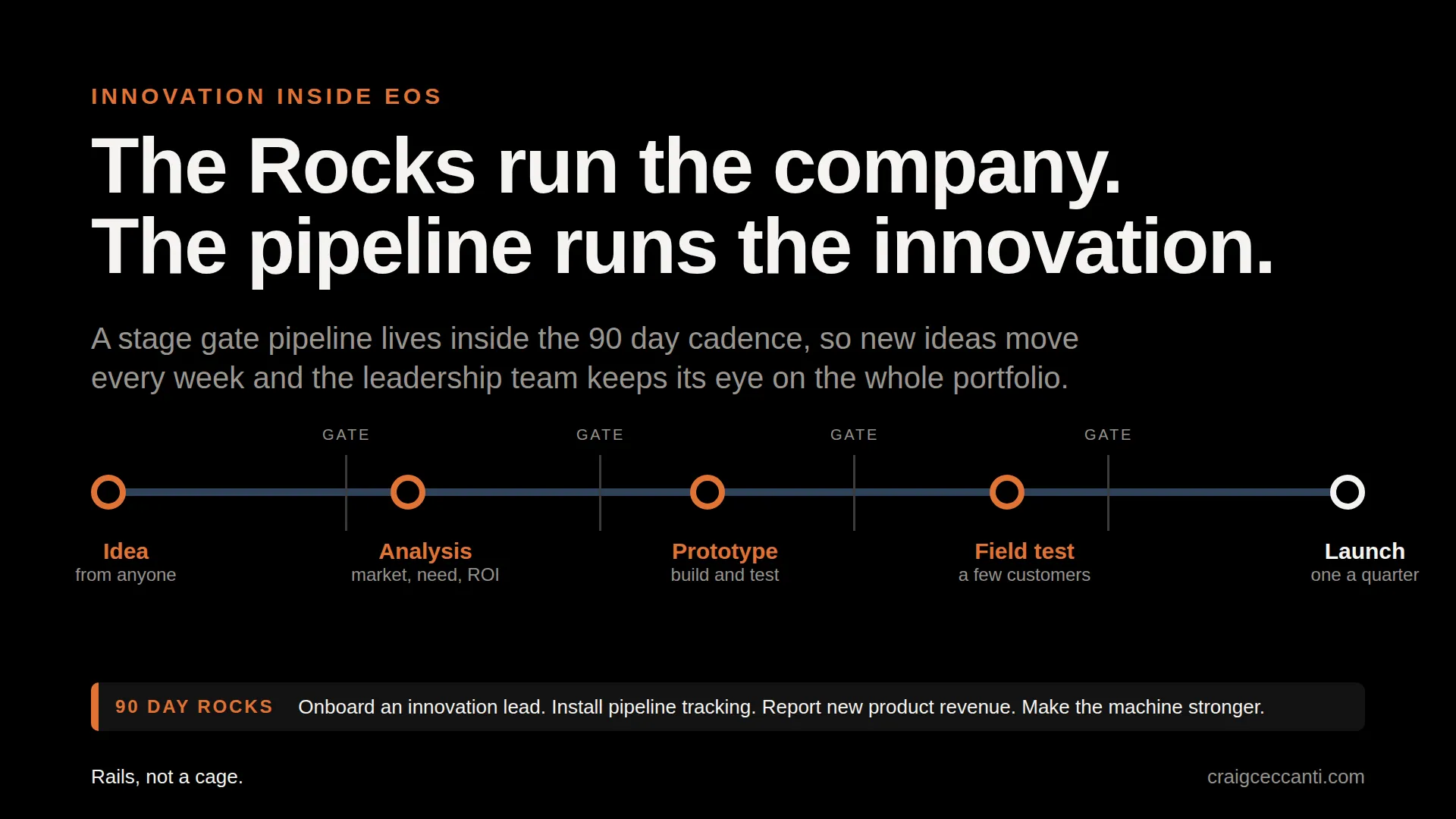
Most of what we did was fix that, and then manage what came in like an asset portfolio. The tool was almost always a stage gate system. An idea stage, where anything could be submitted. An innovation committee that judged each idea against a checklist before it moved. An analysis stage, where somebody actually spent the forty hours on the market, the need, and the return. Then prototype, then launch. At every gate there was a vote. Nothing moved to the next stage on its own.
That sounds like bureaucracy until you see what it does. The whole company gets a place to put an idea. Somebody, usually a head of innovation, owns the pipeline. And the leadership team can finally see the whole portfolio at once: what’s in idea, what’s in analysis, what’s in prototype, and what all of it is costing. Ten things sitting in prototype gets expensive fast. Not all of it has to be new products either. Internal efficiencies, an AI automation, a new way to onboard customers, they all belong in the same pipeline.
The other thing it does is kill the CEO pet project. You know the one. The CEO saw a competitor doing something, decided we need it too, and nobody ever checked whether there was a return or whether we could even build it profitably. Four years and a pile of money later, nobody has the guts to say it was a bad idea, so it just keeps going while the competition pulls away. A gate with a vote gives people a polite, structured way to say no.
When we were scaling Pinot’s Palette, we needed all of this badly. We weren’t a subscription business. We had to earn every customer every week and give them a reason to come back, so new products weren’t a nice to have. They were the model. Early on we innovated the way most small companies do, in bursts. We’d go quiet for months, then suddenly have two or three things ready at once and try to launch them all. Guess what? Our customers couldn’t absorb three new things at once, and neither could our marketing channels.
So we built the stage gate. Idea, analysis, prototype, field test in a few studios, go to market, and a monitoring stage to watch whether a product graduated from “new” to just part of the menu. Five or six stages. Don’t go crazy with it. The innovation committee was our headquarters team plus, mostly, franchisees. They brought the ideas and they held the line at the gates. And because we could see the whole portfolio, we could govern the release schedule. One new release a quarter, timed so our channels and our studios could actually handle it.
Here’s the part that answers the question at the table. That entire system lived inside EOS. Our Rocks were never “launch product A, launch product B, launch product C.” That’s too slow, and it turns the leadership team into the innovation committee. Our Rocks were about the machine itself. Onboard an innovation lead. Install the software to track the pipeline. Build a report that tagged revenue as new product versus existing so we could set a real target for new product revenue each year. Innovation became one of our core processes, documented like the other six to ten, and the quarterly Rocks made that process stronger while the process did the actual innovating every single week.
If you build software, you already know this pattern. Agile and Scrum live inside EOS all the time. You prioritize at the start of a two week sprint, decide who builds what, demo at the end, and maybe release every three months. Nobody waits for the quarterly session to decide whether a feature is worth building. The cadence for building the thing is different from the cadence for running the company, and that’s fine.
I saw the same need later as President and Integrator of an engineering services company. Innovation requests came in from every direction. We needed to get good at AI, computer vision, and digital twins, so people were asking for a GPU here and a training course there, and every one of those was getting approved ad hoc. You don’t want to wait ninety days to decide if you’re investing in that. You also don’t want to say yes to all of it. A budget and a simple pipeline turned a pile of one off requests into a strategy.
Now the honest caveat, because there always is one. A committee, a pipeline, and a person to run it are overhead. Real cost, real time. If you’re a twenty eight year old shop that has machined the same part for twenty years and you’re thinking about adding a line for aerospace customers, Rocks in your quarterly session are probably all the innovation structure you need. You are not running at two week cycles like we were at Pinot’s. Weigh the overhead against the speed you actually require, and build only what the speed demands.
I’ll give you one more tale, because it’s the reason I care about this so much.
When COVID hit, every one of our locations closed overnight. Thank goodness we had EOS installed and the Accountability Chart up, because we knew exactly who owned what. We wiped the Rocks off the board and wrote new ones. And on the day Tom Hanks announced he was sick, we pulled the innovation committee together and made one change. Instead of meeting once a month, we would meet once a week. The pipeline was already there. So the question wasn’t “what do we do,” it was “what in here helps us right now?”
One group went to work on getting painting supplies shipped to people’s homes. One group built a Netflix style version of Pinot’s Palette, where you could rent a video of a class and paint along in your kitchen. Our tech team rebuilt the website around it. Another group figured out the ideal video setup a studio could put together for under a thousand dollars. Those franchisees kicked ass, and I’d say they came within a whisker of saving the company. Not because they were told what to do, but because there was already a place to put the idea and a process to run it through.
That’s what I want the person leaning back at the table to hear. As a Professional EOS Implementer® I see the ninety day cadence get blamed for rigidity that was never really there. EOS gives you the rails. What you run on those rails, and how fast, is up to you. If your business needs a new idea every week, build the pipeline and let the Rocks make it stronger. If it needs one every couple of years, the quarterly will do just fine.
If you want to talk through what your version of that pipeline might look like, or you’ve already built one and want to compare notes, I’d love to hear how you drew it up.